Hagerstown Plumbing Advice: What You Need to Know About Water Heater Leaks

March 21st, 2012

A leak in your Hagerstown water heater can be a big or small problem depending on where the leak is, how severe it is and whether it requires repair or replacement. Here are some things you should know about water heater leaks that will help you determine who to call and how to act.

 Where Is the Leak?

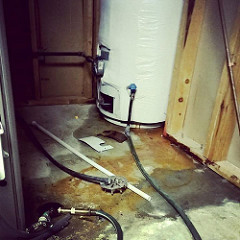
Step one is to determine where the water is coming from. Look for leaks around the fittings and valves attached to the device. If one of them is loose or if you see water dripping from a connection, it can probably be fixed relatively easily. However, if the leak is coming from the body of the water heater, you may have a ruptured tank which is a sure sign of a bad water heater that needs to be replaced.

 Draining Your Tank

Once you identify the leak, turn off the water supply to the tank and prepare to drain it the rest of the way. You should also disconnect the power from the device. If the water heater is gas, I recommend you call a Hagerstown plumber who is certified to work on gas appliances. For electric water heaters, you may still want a professional, but the next step here is to simply turn off the breaker to stop electricity from flowing to the device.

Drain the tank next, using the bucket to capture the water as it is released. If you have a floor drain and can angle the tank over the drain, go ahead and do that now. Once the tank is empty, it is time to tighten your fittings.

 Fixing the Problem

Assuming this is a fittings or valve problem, loosen any fittings that appeared to have leaked, repair the plumbing thread and retape the pipes, finally tightening the fittings back into place. The pressure valve may need to be replaced as well – do this now if it is necessary.

Before reapplying the electricity to the water heater, reattach the water supply and turn it on to check for leaks. If it holds water, you are lucky and your water heater’s tank isn’t leaking. Reattach everything and turn it back on.

If you notice the leak continues, you should call Larry & Sons as it is likely the glass inside your tank has cracked or is leaking. Most of the time, this cannot be repaired and means you need a new water heater installed.

Hagerstown Water Heater Tip: How a Storage Water Heater Works

March 14th, 2012

For decades, people in Hagerstown have used storage water heaters to heat and store hot water for future use. These tanks are very simple and in many cases have become much more energy efficient, but you probably are wondering how they actually work. Here is a quick overview of a storage water heater tank and how it works.

The Basics

A storage water heater is exactly as it sounds. A large volume of water is funneled into a storage tank of between 20 and 80 gallons and heated for future use. When you turn on a hot water tap, water from the top of the tank is removed through the hot water outlet and cold water enters the tank through the cold water inlet – replacing the displaced volume and heated by the gas burner beneath the tank.

Water heaters can be electric, gas, propane or oil depending on what is available in your area. When the water temperature falls (as hot water is pulled from the tank), the thermostat opens and the gas burner ignites, heating the water until it reaches the preset temperature of the thermostat and it closes.

The Tank

When a tank is turned on, it is constantly heating the water supply. As a result, standby heat loss occurs. However, modern tanks are being built with exceptionally high insulation ratings (up to R-25) to minimize the loss of such heat. Additional heat loss occurs in gas and oil water heaters that must vent fumes and gasses through an internal flue. Fan assisted gas tanks and sealed combustion tanks reduce this type of energy loss in gas water heaters.

 Determining the Best Water Heater for You

If you want a new water heater for your home, make sure you do your research and learn what types of water heaters will minimize heat and energy loss without reducing your comfort level. Modern tank water heaters are surprisingly efficient, but only certain ones. Larry & Sons Plumbing, Heating & Air Conditioning can help you determine which option is best for your Hagerstown home.

Gettysburg Plumber’s Guide: Environmental Benefits of Trenchless Repair

March 7th, 2012

Pipe replacement is a messy business. For decades, the only real way to do it was to rumble in with a big machine (or men with plenty of shovels) and dig up your Gettysburg property to access the leaking, cracked pipe. However, with modern technology, trenchless pipe repair and replacement is now possible and while the biggest benefits are to your wallet and your lawn, you might also be interested to know how environmentally friendly the process is.

Less Resources Needed

Have you ever seen someone digging up a pipeline? The equipment needed is impressive. Backhoes, trucks and multiple workers to get the old pipe out of the ground and a new one in. And once the process is completed, the concrete and lawn destroyed by the digging need to be replaced. It’s a very invasive procedure.

With trenchless technology, most of those resources are not needed. This means less fuel used to power large machines, less destruction of your property and no impact on the roadway or sidewalks that would require paving once completed.

Existing Pipe Pathways

Have you ever considered the impact a pipe line being laid has on the ecosystem beneath your property? Digging up all that space and displacing plants, animals and insects alike can have a tremendously negative impact on the micro-ecology on your property.

Trenchless replacement allows a plumber to use the existing pipe pathway beneath your property, which avoids displacing anything with fresh digging. It also doesn’t impact the plants or trees growing on your property. You gain a new pipe line without any damage to the carefully manicured landscaping you’ve done on your property.

Minimal Subsoil Impact

Even when laying new pipes, trenchless technology only affects the space underground where the pipe will be laid. This tears up far less of the subsoil which has a less extensive environmental impact on the water shed around your home.

There really is no reason to use a traditional exhume and pull pipe replacement method when trenchless technology makes it possible to just as easily replace the pipes for the same or less money and minimal environmental impact. Depending on your circumstances and the scope of the work that needs to be done, your pipe repair or replacement may be significantly better served with trenchless technologies.

If you have any questions about trenchless or no-dig technologies, give Larry & Sons Plumbing, Heating & Air Conditioning a call today!

Marlowe Energy Saving Tip: Common Causes of Drafts in Your Home

February 29th, 2012

If you find your Marlowe home’s heating bill is routinely too high, there is a common reason. Most of the time it is due to air leaks and drafts in your home that allow warm air to escape and cold air to enter. Here are some common causes of such leaks and what you can do about them.

Sources of Drafts in Your Home

There are obvious drafts and less obvious ones. Let’s start by looking at the drafts that are most obvious:

  • Outlets and Plates
  • Windows
  • Baseboards
  • Attic
  • Air Conditioners
  • Weather Stripping

You can probably do a quick inspection of your home by yourself to check for these potential air leaks and find whatever may be causing the problem. The easiest way to check for drafts is simply to hold your hand up to the space and check for a change in air flow. You can also get a portable thermometer and see if the air temperature is different in those areas than it is in the center of the room or by the thermostat.

Insulation Inspection

Insulation is probably already in your home, but with time it can thin, get leaks or tear. Look for gaps in insulation or drafts coming through. You can inspect your insulation as well and make sure that it is still holding as much heat in as it was originally rated for. If you know that your insulation values are too low or that the insulation is particularly old, it may be a good time to have it inspected.

Making Changes

If you notice easy to fix drafts in your Marlowe home, fix them immediately and you’ll be shocked by how much energy you save.

If you have any questions about the effectiveness of your heating system, give Larry & Sons a call today!

Hanover Plumbing Guide: What to Look for When You Have Water Damage

February 24th, 2012

Water can be a beautiful thing. But it can be a very nasty thing, too. While water is an essential for life, it brings a high price tag when gone unchecked and allowed to seep, leak, and drain into your Hanover home. Damage caused by water can cause structural damage to a building and destruction of its contents. When left unchecked – over time – water damage can lead to mold growth and have a serious affect on building occupants’ health.

The destructive forces of water leave telltale signs throughout a building. Let’s look at some.

  • Wood damage – water can saturate wood, causing it to rot and decay. Check for discolored wood around plumbing fixtures, a sure sign of an ongoing or older leak that has since been repaired. Just because a leak has been fixed, the after-effects can linger. Soft or uneven surfaces around a plumbing fixture are a sure indication of water damage. Pull back carpeting, pads, tiling, or flooring to get to the root of the problem.
  • Drywall damage – porous material like drywall can leave many signs of water damage and, like wood, can be seriously degraded by water damage. Check for discoloration around plumbing fixtures and soft spots. Don’t assume that a dry surface that is stained is not a structural problem. You may have to cut out the drywall to reach the true source of the water damage.
  • Ceiling tile stains – a sure sign that water is coming in from a source above a roof or ceiling. Ceiling tiles are a porous material that are great for showing every little bit of moisture or water that comes in contact with them. The same is true with plaster or drywall ceilings. Stains indicate a more serious problem and should be investigated right away.
  • Damp, musty smells – water can leave some unpleasant odors, especially untreated water. Leaks or standing water are a source for higher humidity levels in a home. If you are standing in an area where water has soaked into floors or walls, there is often a damp, humid smell. Don’t mistake it for high humidity levels in the home. The smell can come from hidden sources like a leaking pipe joint or broken valve behind an access door.
  • Mold build-up – wood and drywall surfaces provide great food for mold growth when saturated with water. The mold can be of a harmless nature but often can become dangerous black mold. When black mold spores are airborne they can cause respiratory problems and even worse, medial problems down the road. Look for unusual clusters of mold in damp areas and if you find some, immediately call a professional plumber to suggest clean-up and to repair the source of the water leak.

There are many signs of water leakage in the home, caused by leaking or broken pipes, dripping faucets from worn-out washers, cracks in the walls and foundations allowing ground and rain water to seep in, etc. Call a Larry & Sons if you have any signs water damage in your Hanover home.

Myersville Plumber’s Tip: What You Need to Know About Point of Use Water Heaters

February 22nd, 2012

For years, most people in Myersville have used the same system to heat their water. A single tank that heats and stores water at a set temperature for whenever it is needed. That system, as well as it works, is not very efficient, and with costs for gas and oil rising so much in recent years, many people are looking for better ways to heat their water.

That’s where point of use water heating comes in. These tankless water heaters are designed to heat your water when you need it heated instead of filling a tank of 50 or 60 gallons and heating it continuously even when you don’t.

How Point of Use Water Heaters Work

A point of use water heater works by directly heating the water supply to a single fixture. So, you would install a point of use water heater on your kitchen sink and only one water supply pipe would go to that heater. When you turn on the hot water faucet, the point of use heater would turn on (using electricity) and heat your water to 170 degrees F.

These devices only work on a single fixture at a time but they are much less expensive to purchase than a whole house tankless hot water system. Additionally, you can control where hot water is available.

The Advantages of Point of Use Hot Water

A tank hot water system can cost hundreds of dollars of year extra to run, especially if your family doesn’t use much hot water. Imagine what happens if you have four children that go off to college. Your “just big enough” tank suddenly becomes way too big and your bill stays unnecessarily high.

Point of use heaters allow you to decide where hot water is available and have instantly available hot water as you need it. The cost of the units and installation is affordable for most Myersville homeowners and you don’t have to commit to a whole house system if you are not ready.

Happy President’s Day from Your Hagerstown Area Plumbing and HVAC Contractors!

February 20th, 2012

Everyone at Larry & Sons wishes you a happy President’s Day! Today we appreciate all of the great leaders that helped shape our nation. Whether you have the day off today or not, it is a good time to think about how you can help make community a better place. From volunteering to recycling, helping improve your town can be pretty simple. Remember that upgrading your HVAC system can cut down on the amount of fuel you need to keep your home comfortable, and making your home more environmentally friendly is something that helps everyone.

Here is some great trivia about our presidents in honor of this day:

  • The only president who never married
    •  James Buchanan
  • Number of presidents who never attended college
    • Nine (Washington, Jackson, Van Buren, Taylor, Fillmore, Lincoln, A. Johnson, Cleveland, and Truman)
  • Number of presidents who died in office
    •  Eight (Harrison, Taylor, Garfield, Lincoln, McKinley, F.D. Roosevelt, Kennedy)
  • Presidents Portrayed on US coins
    • Lincoln (penny)
    • F.D.  Roosevelt (dime)
    • Kennedy (half-dollar)
    • Eisenhower (dollar coin)
    • Jefferson (nickel)
    • Washington (quarter)
  • Presidents Portrayed on US Currency
    • Washington (one dollar bill)
    • Jefferson (two dollar bill)
    • Lincoln (five dollar bill)
    • Hamilton (ten dollar bill)
    • Jackson (twenty dollar bill)
    • Grant  (fifty dollar bill)
    • Franklin (one hundred dollar bill)

Have a great President’s Day!

Hiring a Jefferson Plumber: What to Look for

February 17th, 2012

There are plenty of situations in which you will need the services of a professional plumber in your Jefferson home. And when you have a plumbing emergency, you really need it to be addressed as quickly as possible. But how do you know which plumber to call? It is likely that all of them can get the job done, but you want to make sure you do not have to pay too much and that the work is done right so that the same problem does not recur in the near future.

Since an emergency repair needs to be done quickly, it is a good idea to come up with a list of possible plumbers ahead of time. Of course, if you are hiring a plumber to work on a new construction installation or home remodeling project, you will have more time to research your options. But it is important to note that, while all plumbers can likely perform repairs, it is better to get someone who specializes in that type of work you need to have done.

When you are evaluating your plumber options, one of the first things to check is whether or not they have all necessary state certifications and licenses. Even if these licenses are not legally required for a plumber to work in your area, it is better to hire someone who has them because you can have greater confidence that they are aware of all of the local codes and restrictions.

If you are hiring a plumber for a home renovation or installation job, be sure to have them come out to examine your house and give you a detailed estimate for the materials and costs involved in the process. You may even want to get several estimates from different plumbers before you make your final decision.

And do not forget one of the greatest resources you have when searching for a plumber – your family and friends. Gathering recommendations from someone who has used a particular plumber before is an excellent way for you to narrow down the potential options and find a Jefferson plumber you can have confidence in. Our motto is “Where Our Customers Send Their Friends” for a reason, so ask around and then give Larry & Sons a call today!

Happy Valentine’s Day from Your HVAC and Plumbing Contractors!

February 14th, 2012

Everyone at Larry & Sons wishes you a very Happy Valentine’s Day! We hope your day is full of love and laughter.  Valentine’s Day is a time to really appreciate all of the wonderful people in your life, including your significant other, your family, and your friends. Take a moment today to let each of them know how special they are to you. Even something simple, like a handmade card, can really make someone’s whole day!

While your HVAC system might not seem like the most romantic place to start your gift giving, a few simple upgrades can make your house more comfortable, which is something your whole family will appreciate! A HEPA filter can keep dust and allergens out of your air, and a new furnace or heat pump can keep your house at more consistent temperatures and cut down on your energy use. An upgrade to your HVAC system is truly a gift that keeps on giving!

For more information about easy ways to improve your home, give Larry & Sons a call! And to help make your Valentine’s Day as happy as it can be, here is a recipe for Chocolate Covered Strawberries:

“This is the simplest version of chocolate covered strawberries I know. Paraffin was originally used instead of shortening. Turn the strawberries upside down and insert by the toothpicks into a piece of styrofoam for easy cooling, or simply place them on a sheet of wax paper. White chocolate may be drizzled over the milk chocolate for a fancier look. They are perfect for weddings when decorated with frosting bow ties, bells, butterflies, roses, etc.”

INGREDIENTS:

16 ounces milk chocolate chips

2 tablespoons shortening

1 pound fresh strawberries with leaves

DIRECTIONS:

  1. Insert toothpicks into the tops of the strawberries.
  2. In a double boiler, melt the chocolate and shortening, stirring occasionally until smooth. Holding them by the toothpicks, dip the strawberries into the chocolate mixture.
  3. Turn the strawberries upside down and insert the toothpick into styrofoam for the chocolate to cool.

For more details, visit allrecipes.com.

Clear Spring Heating Repair Question: What Does a Furnace Thermocouple Do?

February 13th, 2012

Modern appliances are equipped with an array of safety measures to make sure that they operate safely in your Clear Spring home. This includes gas furnaces, which are harmless when working correctly but can be unsafe if something goes wrong. Perhaps the most crucial safety feature of a gas furnace is the thermocouple, also called a flame sensor.

Essentially, a furnace thermocouple works as a kill switch to shut off the furnace in case the gas is not igniting, like if the pilot light is out. Here is how it works.

The thermocouple is made up of two pieces of metal which are welded together at one end, called the “hot end” because it actually sits directly in the path of the furnace flame. On the cold end, it is wired to a circuit. Under normal circumstances, when the furnace is switched on, gas flows through the line and is ignited by a pilot light, ignition spark or glow coil. The flame heats up the thermocouple, and the furnace stays on.

However, sometimes the gas may not ignite, for example if the pilot light is out or the glow coil is faulty. In these cases, if there were no thermocouple, gas would continue to flow out without being lit, creating a very dangerous, poisonous and potentially lethal situation.

What the thermocouple does is detect heat, so if the furnace is on, but the hot end of the thermocouple has not heated up, that circuit up at the cold end kills the power to the furnace so that gas cannot continue to flow out unchecked. That way, you do not have to worry about a gas leak building to dangerous levels without being aware of it.

Sometimes, the thermocouple can malfunction, causing the furnace to shut off even if the burners are working just fine. Usually that is just the result of build up on the hot end over time, which can be fixed with some sand paper or emery cloth. If suspect a problem with your furnace, give Larry & Sons Plumbing, Heating & Air Conditioning a call!